

A quick note from me!…
I’m away at my younger sister’s wedding, celebrating her and everything ahead.
I’m bringing you a piece I wrote last year, when Serena Williams made headlines for using GLP-1s. My DMs had been filling up, people were grieving, and the cultural conversation was loud (and often binary: defend her autonomy, or name the harm.)
This is one of my most read and shared pieces, and while I didn’t expect to be reposting it a year later, I also can’t say I’m surprised. Lately, I’ve been noticing Ariana Grande is the headline, and the same cultural machinery is doing what it always does: some are defending her, some are selling the story, some are concerned, and — ultimately — we’re being asked to absorb the weight of it all.
I don’t have any new answers, but I wanted to return to this piece today because the questions it asks are ones I’m still sitting with — and maybe they’ll help you, too.

“Our beliefs about bodies disproportionately impact those whose race, gender, sexual orientation, ability, and age deviate from our default notions.
The further from the default, the greater the impact. We are all affected— but not equally.”
― Sonya Renee Taylor, The Body Is Not an Apology: The Power of Radical Self-Love
Several days ago, the internet lit up with headlines: Serena Williams announced she’s using GLP-1s for weight loss.
My DMs filled with links, screenshots, and emoji reactions that ranged from heartbreak to fury to resignation. Sad faces. Eye rolls. Angry tears. Underneath it all, I think the word is grief.
I’m not going to dissect Serena here. Not because it isn’t worth talking about, but because one woman doesn’t deserve to be held up as the symbol of an entire cultural mess. More importantly, I am a white woman with immense privilege, and the connection between diet culture and racism is one that cannot be ignored.
As Dr. Sabrina Strings wrote in her book Fearing the Black Body, “the current anti-fat bias in the United States and in much of the West was not born in the medical field. Racial scientific literature since at least the eighteenth century has claimed that fatness was ‘savage’ and ‘black.’”
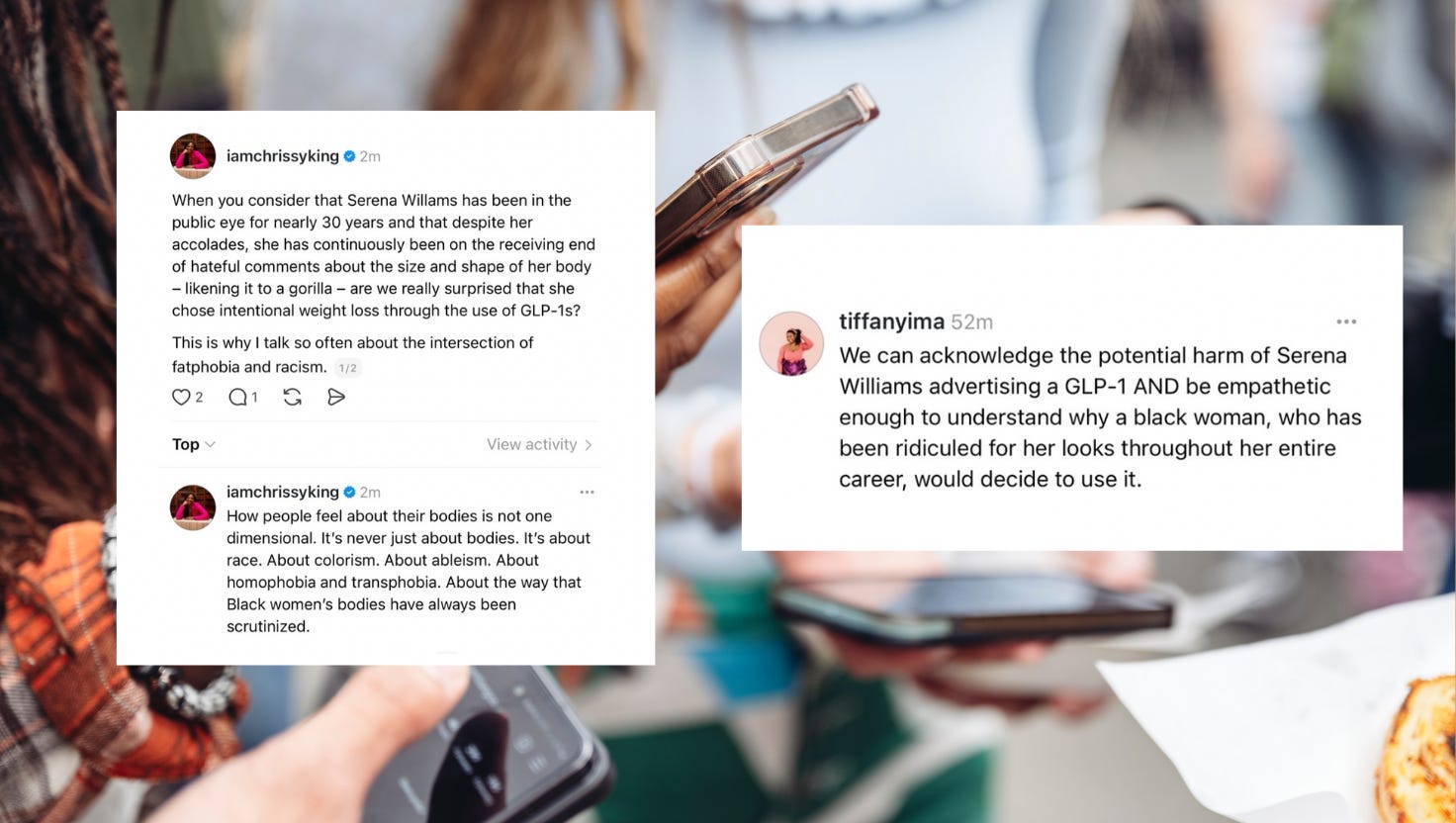
And in response to the Serena media hype, my friend Chrissy King spoke with brilliance and sharpness about the roots of fatness in anti-Blackness — and why that matters when Serena Williams chooses to take GLP-1s. I highly recommend watching that video, and supporting her work on Substack.
So, what am I writing about then?
The bigger, zoomed-out picture of how this body shaming (and, equally, the celebrating) impacts us. And more specifically, some reflections that I hope can meet you wherever you are.
Because a few weeks ago, in my membership group, the topic of our monthly session just happened to be about celebrities, GLP-1s, and weight loss in the media.
The conversation was real, messy, funny, painful—all of it. People brought their anger, their disappointment, their fear, their grief. And together, we tried to make sense of what it means to live in this constant swirl of body commentary, shrinking, and “health journey” narratives that are often just anti-fat bias in new packaging.
What stayed with me most wasn’t the answers—we didn’t leave with neat resolutions—but the honesty. The way people admitted how hard it is to hold both compassion for individuals and accountability for harmful systems. The way grief and anger sat side by side, making space for each other.
That’s what I want to offer you here: not another hot take, but a gentle invitation.
To pause. To feel what this moment stirs up in you. To notice how much of that weight you’re carrying belongs to you, and how much was placed on your shoulders by a culture that insists thinner is always better.
Because if there’s one thing I know, it’s this: you were never the problem. The system was. The system is. And together, we can keep imagining—and fighting for—something different.
Here are 7 questions we pulled on together in that group session, along with the discussions they ignited:
What is the social cost of the GLP-1 obsession?
Beyond the very real physical side effects, there’s a cultural cost. Every time