

I try not to do much scrolling lately, but whenever I do, I catch wind of the latest celebrity weight loss story, and the cultural conversation that ensues.
Right now, we’re witnessing the return of the 90’s “heroin chic.” The hollow clavicle, the drawn cheeks, and the visible ribs. We've seen the circulating photo of Demi Moore’s arms, the commentary on Olivia Wilde's temporal wasting, the think pieces about “Ozempic face.” The aesthetic of deprivation is being presented as something to aspire to, and people are rightfully alarmed. Commentators are writing about it, social media is full of takes, and the takes are not necessarily wrong.
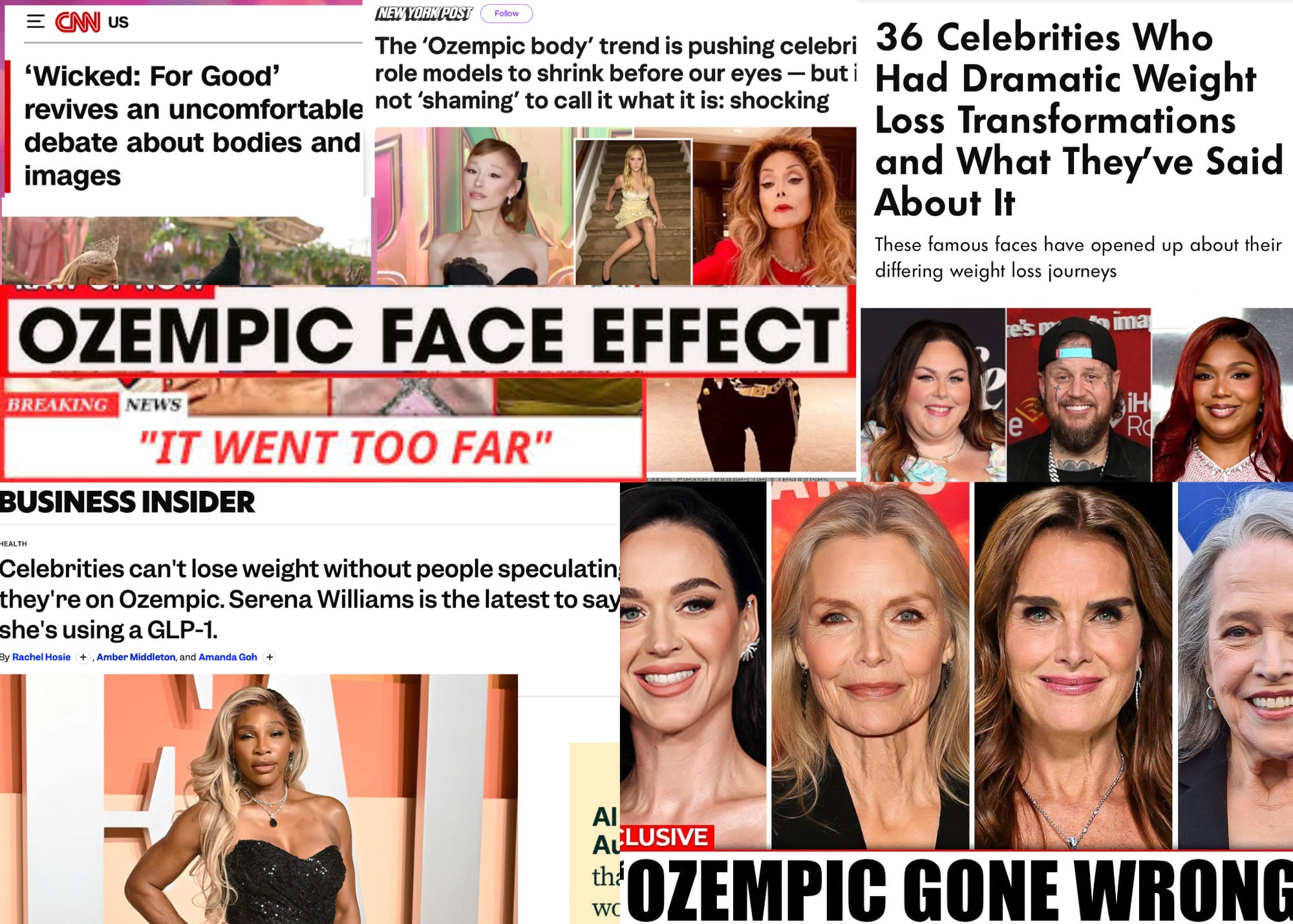
The fact that extreme thinness is trending is absolutely causing harm, and it’s a problem worth naming, discussing, and (hopefully) learning from. But I keep getting stuck on what the conversation is missing. Or, more precisely, what it's not worried about when it's not worried.
We (as a culture) have never actually been worried about restriction. We have just been worried about the look of it. And those are not the same thing.
Malnourishment Can Happen at Any Weight.
I work in disordered eating recovery, and as many of you know, I’ve healed from disordered eating myself. I also work with folks who have never seen themselves as someone with disordered eating at all — just a person who tried to “eat healthy”, who tried to lose weight, who dabbled in different diets, and who inevitably wound up in a distressing cycle with food, body image, and self-worth.
I sit with people across the weight spectrum who are experiencing restriction, and are starving. Not metaphorically, but physiologically. Yes, even just the casual dieters. Yes, even if they aren’t “thin.” Yes, even if they are “weight stable.” Because contrary to what we’ve been led to believe within the context of anti-fat bias, malnourishment can occur in any body, at any weight.
When I say restriction, I’m talking about an array of practices that result in eating less than your body needs to function and thrive. Restriction that affects cognition, mood, sleep, cardiovascular health, bone density, hormonal function, mental wellbeing, and long-term health outcomes. Restriction that leaves bodies in genuine crisis, even though that crisis is something diet culture refuses to own. (In fact, it will probably try to sell you a supplement for that.)
What I’ve learned from witnessing that spectrum of stories is this:
The presence or absence of societal alarm around bodies has almost nothing to do with whether the body is actually suffering. It has everything to do with whether the body looked like it was suffering. And, more specifically, whether it looked like it was suffering in the particular way that our culture has designated as visible, recognizable, and worthy of concern.
The Thinness Threshold.
A person in a larger body who is restricting is almost never the subject of worry. In fact, they are much more likely to receive compliments and even be actively encouraged by their doctor. The same behavior, with the same physiological underpinning, lands entirely differently because the size of the body doing it doesn’t trigger the alarm.
This is the thinness threshold, and it is not protecting anyone. The current panic about skinny-worship and GLP-1-era thinness aesthetics is, at its core, still operating within this framework.
Regardless of the dieting method, people are only alarmed when bodies start to look a certain way — a way that has historically been coded as ‘they’ve gone too far.’ So what we keep asking is: does this person look like they have a problem? — instead of: does this person have permission to nourish themselves without a ceiling, and is this person being harmed by the way our culture relates to food and bodies and hunger?
What frightens me most is how rarely that second question gets asked, and how structurally guaranteed that silence is. Because what the research actually tells us is that the body that reads as "too thin"